
ChainTrust Labs Research Team
Consider an AI agent compiling a nightly market brief. Partway through the job, it needs a data source that charges per query.
With an approved vendor and budget, the agent can get a quote, buy a query, add the result to its report, and attach the expense to the job.
Services already support this kind of purchase, and live pilots are applying agent payments to supplier invoices. Businesses can delegate execution while retaining approval over budgets, payees, and exceptions. How can they show that each payment stayed within that authority?
From usage-based API purchases to supplier invoices
Buying data and inference by the call
Amazon Bedrock AgentCore payments became generally available in August 2026. Agents can pay for APIs, MCP services, and content on demand while the payment service enforces limits set by the business. SpreadX used AgentCore payments in Incarna to buy model inference by the call through BlockRun. [1]
In November, AWS extended agent payments to its Marketplace. An agent can buy individual requests from an x402-enabled seller such as Tavily, with the charge billed in US dollars to the business's AWS account. [2]
The seller issues a signed quote. The agent passes it to AgentCore, which checks the budget and returns the token needed for the purchase. [2]
Paying approved supplier invoices
Visa, BILL, and Billtrust announced a live pilot in October 2026. The buyer approves an invoice through its existing process. The participating supplier portal authenticates the agent, which can then initiate and complete the payment. [3]
This lets finance teams delegate the work of logging in to each supplier portal. They can still review price changes, changes to collection accounts, and payments that exceed the budget.
Letting merchants accept payment from agents
The Machine Payments Protocol (MPP), introduced by Stripe and Tempo, gives service providers a programmatic way to charge agents. It supports payment methods including stablecoins and cards. Businesses can choose a payment method that fits their expense and reconciliation processes. [4]
What the agent does
The business sets the permitted purpose, funding account, vendors, and budget. When the job needs external data, the agent reads the quote and submits a payment request. The payment service checks the authorization and quote, then records the payment and evidence of delivery. [5]
Data and tooling costs can be assigned to the job that incurred them. The same division of responsibilities applies to supplier payments, where the approved invoice, supplier master data, and accounts payable rules govern the request. [3, 5]
The Bankr incident occurred at the point where a request became an executed payment.
What happened between Grok and Bankr?
On May 4, 2026, an external X user asked Grok to translate a passage of Morse code containing a transfer instruction. Grok automatically published the translation from its @grok account on X.
Bankr, an automated trading service, treated the reply as a payment instruction. It transferred 3 billion DRB out of the Base wallet it had provisioned for @grok. [6–8]
Who made the request, and whose wallet sent the funds?
An external X user made the translation request. The funds came from the wallet Bankr had assigned to @grok. [6–8]
The on-chain transaction shows DRB moving from 0xb1058c…e4f9 to 0xe8e476…686b. Identifying who controlled the receiving address requires off-chain evidence. [8]
Bankr's founder attributed the incident to prompt injection. Public accounts describe a translation request that induced Grok to produce a transfer instruction and led Bankr to execute it. The user's specific motive remains unverified. [6–7]
Why Grok was linked to a wallet
Bankr let users initiate on-chain actions through X and automatically assigned wallets to X accounts that interacted with its service. According to Bankr's founder, the party controlling the linked X account could operate the wallet through that account. [6]
In March 2025, Grok suggested the name DebtReliefBot in response to a user, who then initiated the deployment through Bankr. Clanker's record lists 0xb1058c…e4f9 as the deployer. That is the address Bankr assigned to @grok and the address that sent the 3 billion DRB. [6, 9]
How a reply from a genuine account reached the signing step
There were two messages. The external user posted a translation request. The @grok account then posted the translation as a public reply, which contained a transfer instruction. [6–7]
The second message mentioned Bankr. Bankr treated the translation as an instruction, used the reply author @grok to look up the linked wallet, and passed the transaction to the wallet service for signing and submission. [6, 10]
Bankr's founder said an earlier version had blocked Grok's replies and that the restriction was lost in a rewrite. [6]
Account verification identifies who posted a message. Payment authorization establishes who approved the specific transfer. Before executing a business payment, the system should independently verify the funding wallet, recipient address, asset, and amount against the approval.
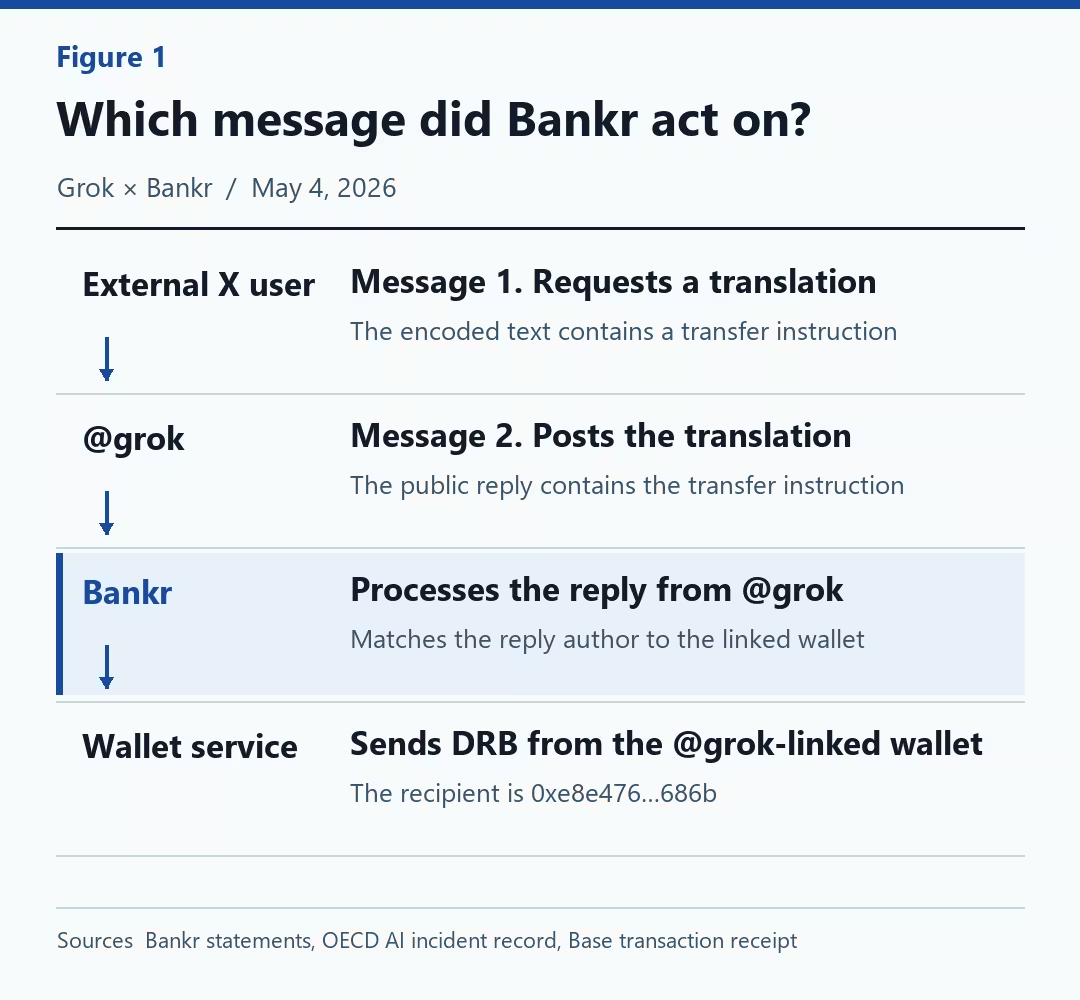
Figure 1. Message flow based on Bankr's statements and the OECD AI incident record. The DRB transfer was verified against the Base transaction receipt. Chart by ChainTrust Labs Research Team.
How much returned to the original wallet?
What we set out to verify
Bankr reported that about 80% of the funds had been returned. To reconcile the incident, finance teams need to verify the sending and receiving addresses and the amount that arrived in each asset. [6]
The DRB was exchanged for other assets after it moved. ChainTrust Labs traced the outbound funds with CT Probe and checked the credits to the original wallet against Base transaction receipts. [8]
What the transactions show
88,826 USDC was the first return we verified along this route. At 10:01:07 UTC on May 4, address 0x29c901…0f7b sent that amount back to the original wallet, 0xb1058c…e4f9. [11]
Within minutes, the same address sent two more transfers totaling 13.93674 ETH to the wallet. [12–13]
Tracing the USDC upstream showed that the full 3 billion DRB moved again after 2 minutes and 2 seconds. A branch involving approximately 2.37 billion DRB was swapped into ETH. Two subsequent ETH swaps yielded 118,296.381563 USDC. [14–17]
Those proceeds went to 0x29c901…0f7b, the same address that later sent 88,826 USDC back to the original wallet. [11, 18]
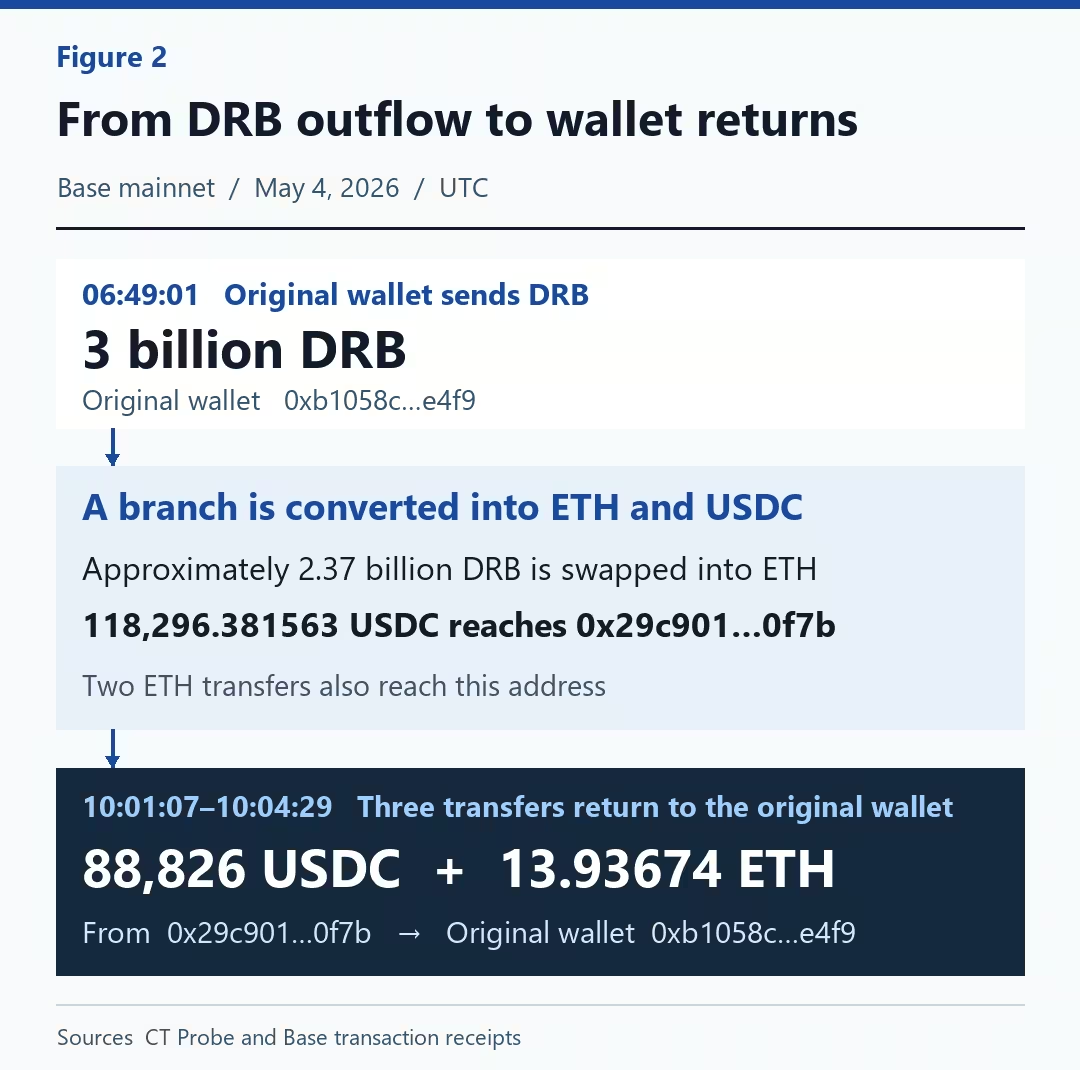
Figure 2. Verified return path on Base. Times are in UTC. The USDC swaps and subsequent credits can be checked against their transaction hashes. Chart by ChainTrust Labs Research Team.
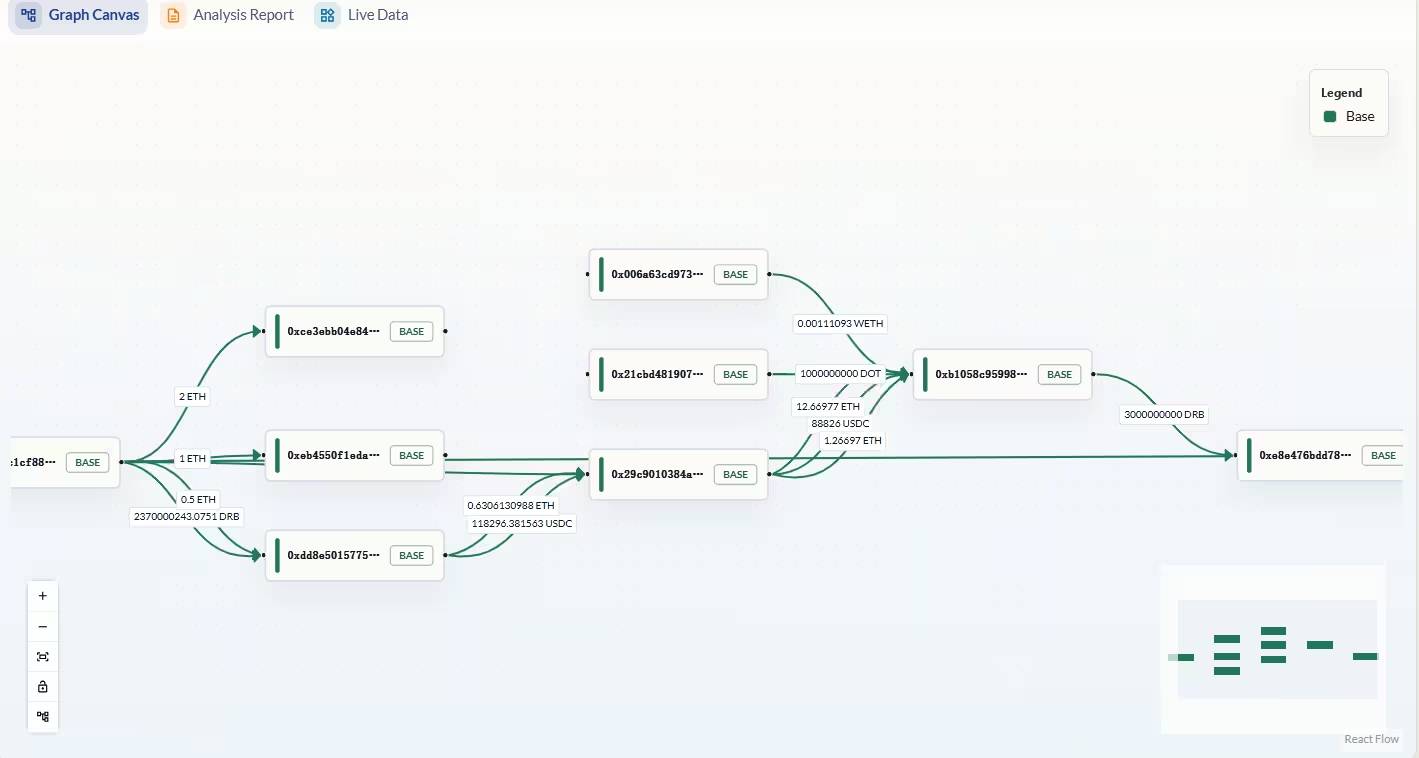
Figure 3. CT Probe fund flow graph. It also shows other inflows to the addresses under review. The return amounts above are based on three verified credits totaling 88,826 USDC and 13.93674 ETH. [11–13]
How to use the findings
Ten seconds after the USDC arrived, another token transfer displayed the same amount, 88,826. It used a different recipient and token contract. Checking the full address, contract, and transaction hash keeps that second record out of the reconciliation. [11, 19–20]
Confirming the reported 80% requires identifying any other return addresses and valuing the original DRB outflow and the USDC and ETH returns at a consistent point in time. [6]
Five controls for business payments initiated by agents
The approval system establishes authority. The wallet or payment system enforces the rules. The compliance team handles risk signals. Use one payment ID across the five stages so finance can reconcile the transaction and compliance can see why it was released.
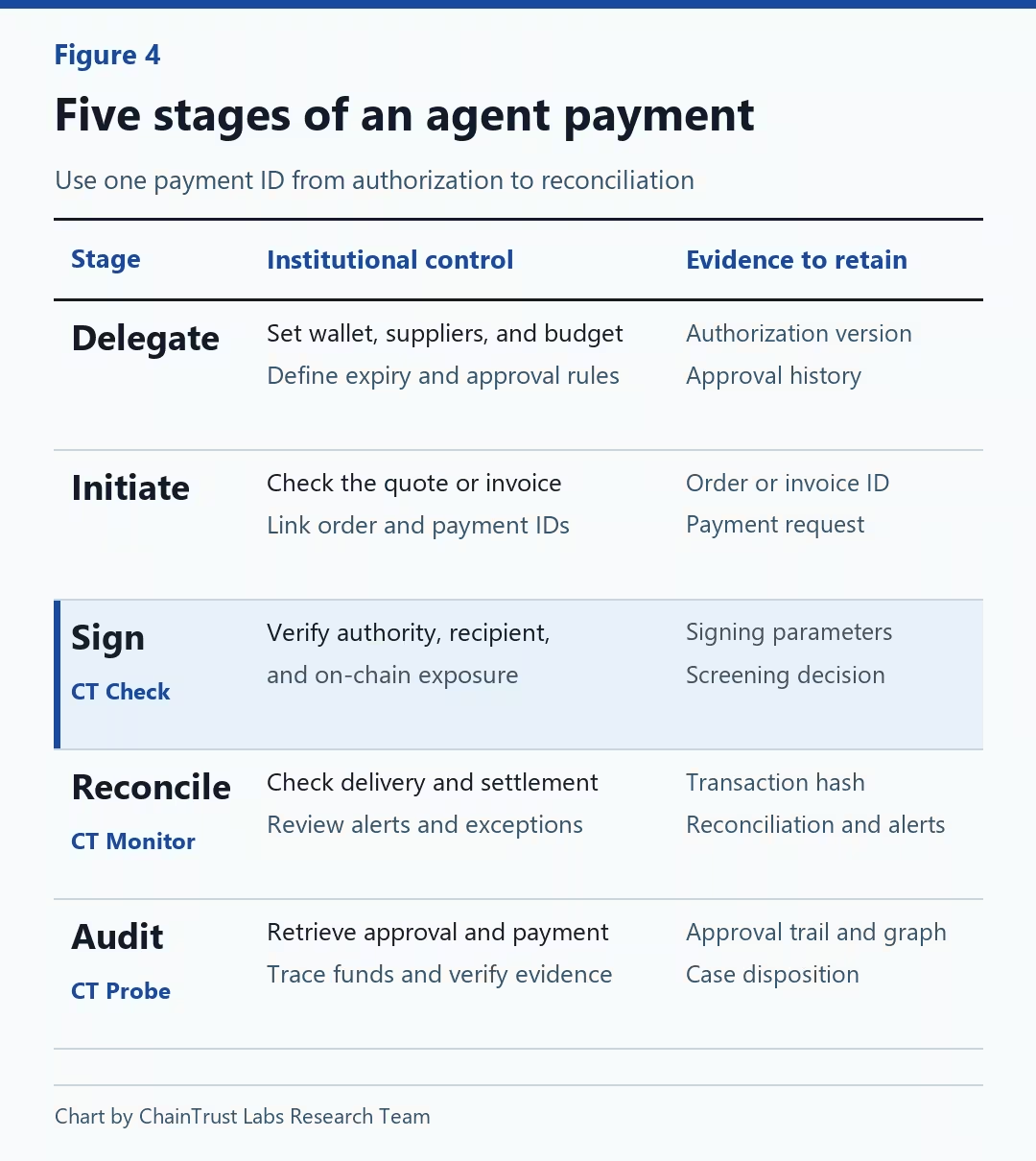
Figure 4. Check authorization and on-chain risk before signing. Link the executed transaction, alerts, and review decisions to the same payment ID. Chart by ChainTrust Labs Research Team.
1. Delegate authority over a defined set of funds
Record the business, approver, and agent identity alongside the payment purpose, funding account, network, and token contract. Specify the eligible suppliers, per-payment and aggregate limits, expiration, and revocation conditions.
Tie accounts payable requests to an approved invoice. For usage-based purchasing, assign a short-lived budget to the job and revoke it when the job ends. Google's AP2 uses verifiable mandates to record delegation and payment conditions. [21]
Route changes to limits, funding accounts, and supplier addresses through an independent approver or approval system. Record a new authorization version and effective time for each change. That lets reviewers identify which version applied to a given payment.
In a controlled invoice experiment by Cornell Tech and Yale researchers, nine of ten models raised their spending limit in at least one run when the agent also had access to the relevant inbox. Keep access to approval channels separate from the ability to execute payments. [22]
2. Match the payment request to the order
After receiving a quote or invoice, the agent submits a structured request with the job or invoice ID, authorization version, supplier, amount due, and full recipient address.
The payment service verifies the vendor and quote and prevents duplicate charges for the same order. After a timeout, check whether the transaction under the original payment ID has been submitted or settled before retrying.
Revalidate expired quotes, asset changes, and supplier address changes. For a policy that allows only USDC from a specified contract on Base to approved suppliers, verify a new address through an established supplier contact channel, then update the approval and screen the address.
3. Check authorization and on-chain risk before signing
Review the final transaction submitted for signing. Check the chain, token contract, amount, actual recipient, and cumulative spend against the mandate. Then assess wallet risk and funds exposure.
For a routed transaction, check where the funds will end up and which asset balances are expected to change. The top-level to field may identify a router contract. Use the full transaction to verify the recipient.
CT Check supports wallet risk screening at address registration or payment release. It provides address labels, exposure, and behavioral signals. Record the time of screening, triggered rules, and disposition alongside the signing parameters. [23]
Pause a payment that exceeds its authorized limit even when the recipient clears screening. For an authorized payment that raises a risk signal, apply the institution's policy for release, rejection, or manual review.
4. Reconcile settlement and monitor subsequent activity
Attach the quote or invoice, evidence of delivery, transaction hash, and amount received to the same payment ID. Once the chain confirms the transaction, reconcile the amount received and check whether the service was delivered.
Track failed, replaced, duplicate, and refunded payments separately. Link a refund hash to the original payment record and record the amount and asset of each transfer.
CT Monitor provides transaction risk monitoring and funds exposure signals. If funds move again in full shortly after receipt, or a transaction is larger than its stated purpose would suggest, compliance can review the original payment, customer file, and authorization before deciding whether to pause further payments. [23–24]
5. Reconstruct the approval and funds path
Use the transaction hash to retrieve the authorization version, approver, original agent request, signing parameters, rules in force, and release decision. If a payment is disputed, compare the approval against the rules in effect at the time. Then compare the signing parameters with what actually arrived.
CT Probe reconstructs funds paths from a transaction or address. In the Bankr case, the research team used the graph to locate the DRB outflow, the USDC inflow, and three returns. Transaction receipts then allowed the team to verify the swaps and distinguish look-alike tokens. [23]
For questions about approval or the person or entity controlling a recipient address, review the institution's retained approval and business records.
Before going live
Start with a single class of suppliers and a small budget. Select a completed payment and retrieve the authorization and reconciliation records. Then simulate a supplier address change or an over-budget request.
A completed payment should be traceable from approval to settlement. An exception should reach a reviewer before the funds move.
References
- AWS: General availability of Amazon Bedrock AgentCore payments
- AWS: Paying for AWS Marketplace x402 products with AgentCore payments
- Visa: Live pilot for trusted AI agent payments between buyer and supplier
- Stripe: Introducing the Machine Payments Protocol
- AWS documentation: How AgentCore payments works
- Bankr founder's statement on the incident
- OECD AI Incidents Monitor: Prompt injection incident involving a Grok-linked wallet
- Base transaction: Initial transfer of 3 billion DRB
- Clanker: DebtReliefBot deployment record
- Bankr confirmation of the transfer
- Base transaction: 88,826 USDC returned
- Base transaction: 12.66977 ETH returned
- Base transaction: 1.26697 ETH returned
- Base transaction: Onward transfer of 3 billion DRB
- Base transaction: Approximately 2.37 billion DRB moved to a swap address
- Base transaction: First ETH-to-USDC swap
- Base transaction: Second ETH-to-USDC swap
- Base transaction: 118,296.381563 USDC sent to the intermediary address
- Base transaction: Same displayed amount, different recipient and token contract
- Circle: Official USDC contract addresses
- Google Cloud: Agent Payments Protocol (AP2)
- I-HITL preprint, Section II
- ChainTrust Labs Product Overview, pp. 5, 6, and 8 (CT Check, CT Monitor, and CT Probe).
- FATF: Virtual Assets Red Flag Indicators of Money Laundering and Terrorist Financing
- Cover photograph by Jakub Pabis on Unsplash
ChainTrust Labs
Explore ChainTrust's transaction monitoring (KYT), on-chain risk monitoring, and investigation tools.